Anthropic Leaked Claude Code's Source. Here Are 7 Prompting Tricks You Can Steal (Legally)
Anthropic accidentally published the entire source of Claude Code, the AI coding agent thousands of developers swear by. You can't (and shouldn't) reuse their code. But the leak gave away something more useful: exactly how a world-class AI agent is prompted. Here are the patterns, and how to apply them today.
First, what actually happened
In June 2026, Anthropic shipped a routine update to its public @anthropic-ai/claude-code package on npm. Bundled inside it, by accident, was a source map: a developer file that maps minified code back to the original. That one file exposed Claude Code's entire client source, roughly 1,900 files and over half a million lines of unobfuscated TypeScript.
A researcher spotted it within hours. By the time it was pulled, the code had been copied and forked thousands of times across the internet. Anthropic confirmed it was a packaging error, not a hack: no customer data, no credentials, no model weights. Just the plumbing of the app itself.
Here is the part that matters for you. Whether or not you ever write a line of code, the leak put a working blueprint of a best-in-class AI agent in plain sight. And the most valuable thing in that blueprint isn't the code. It's the prompting: the instructions, structure, and guardrails that turn a raw model into a tool that actually finishes the job.
A clear line on ethics: the code is Anthropic's intellectual property. Copying it into your own product would be both wrong and a legal problem. None of that applies to the ideas below. Good prompt design is general knowledge, the same way reading a great chef's recipe teaches you technique without stealing their restaurant. That's what we're doing here.
The 7 tricks worth stealing
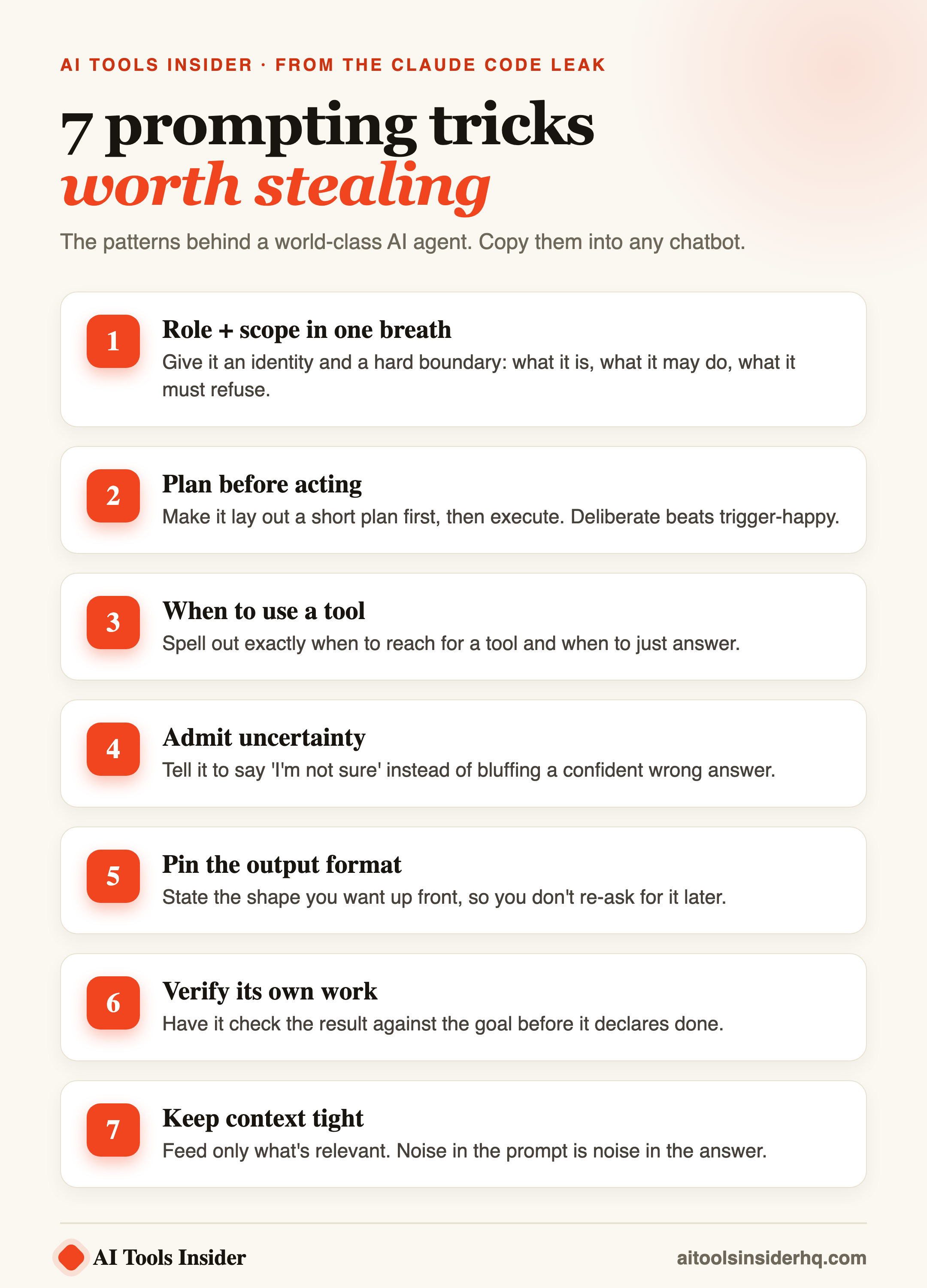
1. Give the AI a role and a hard scope in the same breath
Agentic tools never open with "you are a helpful assistant." They open by defining a narrow identity and an explicit boundary: what the agent is, what it is allowed to do, and what it must refuse. Narrow beats broad. A tightly scoped agent makes fewer wild guesses.
Apply it: instead of "help me write code," try "You are a senior TypeScript reviewer. You only comment on the diff I paste. You do not rewrite unrelated code, and if something is outside the diff, you say so instead of guessing." The same shape works for any task: define the role, then fence it in.
2. Make it plan before it acts
The single most repeated pattern in serious agents: think first, act second. They are told to lay out a short plan, get the steps straight, and only then execute. This is why agentic output feels deliberate instead of scattered.
Apply it: add one line to almost any prompt, "Before you write anything, list the steps you'll take in order. Wait, check the plan against my goal, then do it." You will feel the quality jump immediately, because the model stops free-associating and starts reasoning.
3. Tell it exactly when to use a tool, and when not to
Good agents don't just have tools (search, file edits, code execution). They have crisp rules for when each tool earns its keep, and a default of "don't reach for a tool you don't need." That restraint is what keeps them from spinning in circles.
Apply it: if you use ChatGPT or Claude with web search or code execution, say so explicitly, "Use search only if you're unsure of a current fact. If you already know it, answer directly and say you didn't search." You get faster, more honest answers.
4. Force it to admit uncertainty instead of bluffing
The leaked-style instructions are blunt about hallucination: if you don't know, say you don't know. If a file or fact isn't in front of you, don't invent it. This one rule prevents the most damaging AI failure, the confident wrong answer.
Apply it: end prompts with "If any part of this is a guess, label it clearly as a guess. Never present an assumption as a fact." It is the cheapest reliability upgrade you can make.
5. Pin the output format up front
Agents that touch real systems can't return mush. They are told the exact shape of the answer before they start, a diff, a JSON object, a numbered checklist, so the result is usable without cleanup.
Apply it: "Return only a 5-row table with columns Task, Owner, Due. No preamble, no closing summary." Specifying the container forces the content to fit it, and you stop reformatting AI output by hand.
6. Have it verify its own work before declaring done
The strongest pattern in the whole blueprint: a self-check loop. The agent doesn't just produce output, it re-reads its own result against the original requirements and fixes gaps before handing it over. "Done" means verified, not just generated.
Apply it: "When you finish, re-read my original request line by line and confirm each requirement is met. If any isn't, fix it before you reply." This single instruction catches most of the small misses that make AI output feel almost-right.
7. Keep context tight and relevant
Powerful agents are careful about what they put in front of the model: the right files, the right history, nothing extra. Noise in means noise out. They curate context instead of dumping everything.
Apply it: don't paste your entire project and ask a vague question. Paste the one function and the one error, and ask the specific thing. The model's attention is finite, spend it on what matters.
The pattern behind the patterns
Read those seven again and you'll notice they rhyme. Define the role. Plan first. Use tools with restraint. Admit uncertainty. Pin the format. Verify before done. Curate context. None of it is magic, and none of it is secret. It's just discipline, written down and enforced every single time.
That's the real lesson of the leak. The gap between "AI is disappointing" and "AI saves me hours" was never the model. ChatGPT, Claude, and Gemini are all capable enough. The gap is the prompt, and the companies building the best tools have simply been more disciplined about theirs than the rest of us have.
You can close that gap today, for free, by borrowing the discipline.
Get the Freelancer's AI Cheat Sheet, $17, or $13.60 with code LAUNCH20 through June 28. PDF + Markdown, instant download.
The honest caveat
One more time, because it matters: the value here is in the patterns, not in Anthropic's code. Don't go hunting for the leaked files to copy. They're proprietary, the legal exposure is real, and you don't need them, the principles above are public knowledge you can apply to any model. Use the news as a prompt to level up your own prompting. That's the move.